
A phone case can look polished in a product rendering and still feel awkward the moment someone picks it up. If the grip is uncomfortable, poorly positioned, or unreliable, customers will notice it long before they appreciate the color palette or logo placement.
For brands developing functional cases, grip design affects much more than appearance. It can influence one-handed use, drop prevention, wireless charging, product thickness, assembly time, production yield, packaging, and long-term warranty risk.
A small change to a finger loop, magnetic ring, elastic strap, or textured sidewall may also require changes to the mold and assembly process. As with the broader phone case manufacturing process, decisions made during the design stage can determine whether a product is practical to manufacture at scale.
Before moving into tooling or mass production, brands should evaluate the phone case grip design as part of the complete product—not as an accessory added at the end.
What Is a Phone Case Grip Design?
A phone case grip design is any structural or surface feature intended to help users hold and control their phones more securely. Some grips are built directly into the case, while others attach magnetically, mechanically, or with adhesive.
Built-in grip features may include:
- Textured or ribbed sidewalls
- Soft-touch gripping areas
- Integrated finger loops
- Elastic hand straps
- Foldable rings
- Built-in grip-and-stand structures
Removable options include:
- Magnetic ring grips
- Pop-up grips
- Adhesive finger loops
- Detachable straps
- Magnetic grip-and-stand accessories
The distinction matters during product development. A textured sidewall may only require adjustments to the mold surface, while an integrated rotating ring could introduce additional components, assembly steps, tolerance requirements, and durability tests.
A removable grip may be faster to develop, but it creates a different set of questions around attachment strength, accessory compatibility, packaging, and replacement parts.

Common Types of Phone Case Grip Designs
There is no single grip structure that works for every brand. The right option depends on the target customer, intended use, retail price, visual identity, and level of customization.
| Grip design | Main advantage | Wireless charging risk | Customization complexity |
|---|---|---|---|
| Textured side grip | Slim and easy to use | Low | Low to medium |
| Finger loop | Secure grip with minimal bulk | Low to medium | Medium |
| Elastic strap | Comfortable for extended use | Medium | Medium |
| Rotating ring | Combines grip and stand functions | Medium to high | Medium to high |
| Pop-up grip | Large gripping area | High if fixed | Medium |
| Magnetic grip | Removable and modular | Low when removed | Medium |
| Built-in grip stand | Strong product differentiation | Medium to high | High |
Textured Side Grips
Textured sides are one of the simplest ways to improve grip without adding noticeable thickness. Ribs, grooves, dots, or geometric patterns can increase friction while preserving a clean silhouette.
However, deeper texture is not automatically better. Aggressive ribs can feel uncomfortable, collect dirt, or make the case harder to remove from a pocket. If the pattern is too shallow, it may provide little improvement over a smooth surface.
Brands should evaluate textured grips using actual molded samples. The final feel depends on the material hardness, mold finish, pattern depth, and any surface coating applied after molding.
Finger Loops and Elastic Straps
Finger loops are lightweight and intuitive. They work well for lifestyle products, fashion collections, and cases intended for frequent one-handed use.
Placement is critical. A loop that feels natural for a right-handed user may be inconvenient for someone holding the phone with the left hand. Fixed loops also need enough space for different finger sizes without feeling loose or restrictive.
Elastic straps distribute pressure across a larger area and may be more comfortable during extended use. Their main weakness is material fatigue. Repeated stretching, exposure to sweat, and everyday contamination can cause a strap to loosen, fade, or become stained.
Ring Grips
Ring grips remain popular because they combine secure handling with hands-free viewing. A rotating ring can support portrait and landscape positions while staying relatively compact when folded.
The user experience depends heavily on mechanical quality. A ring that is too tight feels difficult to open. A loose ring may collapse when used as a stand. The rotation mechanism needs to maintain consistent resistance after repeated use.
Brands considering this structure can review how different materials and configurations are used in magnetic ring grips. Existing products such as a rotatable magnetic phone ring grip may also offer a faster development path than building a completely new mechanism.
Magnetic Grips
Magnetic phone grips give brands more flexibility because users can remove the accessory when charging or switch between a grip, wallet, stand, and car mount.
This modular approach can help a brand develop an accessory ecosystem rather than a single product. It also places more pressure on magnetic performance. A grip that feels secure during normal handling may still slide or detach when the phone is shaken, rotated, or held at an angle.
Magnetic strength must be evaluated with the complete case structure. Case thickness, magnetic ring position, accessory weight, and the materials between the magnets all affect performance.
Start With the Target User
A strong phone case grip design begins with a clear use case.
A grip developed for a compact fashion case will have different requirements from one designed for outdoor work, mobile gaming, content creation, or users with limited hand strength.
Before selecting a structure, brands should ask:
- Will users operate the phone primarily with one hand?
- Is the case intended for large or heavy smartphones?
- Will customers use it for photography or video recording?
- Does the grip need to support landscape viewing?
- Should it work equally well for left- and right-handed users?
- Will users frequently remove and reattach the grip?
- Is the customer likely to use a magnetic wallet, charger, or car mount?
Large phones create an additional challenge because the grip must help users reach more of the screen without shifting the device into an unstable position. If the grip sits too high, too low, or too far to one side, it can make the phone feel less balanced rather than more secure.
Ergonomics Should Come Before Styling
Grip comfort is difficult to judge from a CAD file alone. The design needs to be tested with real hands and real devices.
Research into ergonomic smartphone forms and grip comfort has identified device dimensions and mass as important design considerations. This is particularly relevant as larger phones place more strain on one-handed use.
Position and Balance
The grip should sit close enough to the phone’s center of gravity to provide stable control. At the same time, it cannot interfere with the camera, charging coil, buttons, or internal magnetic ring.
A few millimeters can change how the phone rests in the hand. The ideal position may also vary between a standard phone and a larger Pro Max or Ultra model. Using one grip location across every device size may simplify development, but it does not always create the best user experience.
Finger Space and Pressure Distribution
Finger loops and rings should provide enough space for different hand sizes. Edges must be rounded, and contact surfaces should distribute pressure rather than concentrate it on one part of the finger.
Comfort should be evaluated over more than a few minutes. A ring that feels secure during a quick sample review may become uncomfortable during a long video call, commute, or filming session.
Left- and Right-Handed Use
Centered grips are generally more flexible, but they may limit thumb reach. Offset grips can improve one-handed control for some users while making the product less universal.
If the position is fixed, brands should test it with both hands before approving the structure. Another option is to use a rotatable or repositionable grip that lets users select their preferred angle.
Choosing the Right Phone Case Grip Material
Material selection affects comfort, durability, appearance, and manufacturability.
TPU
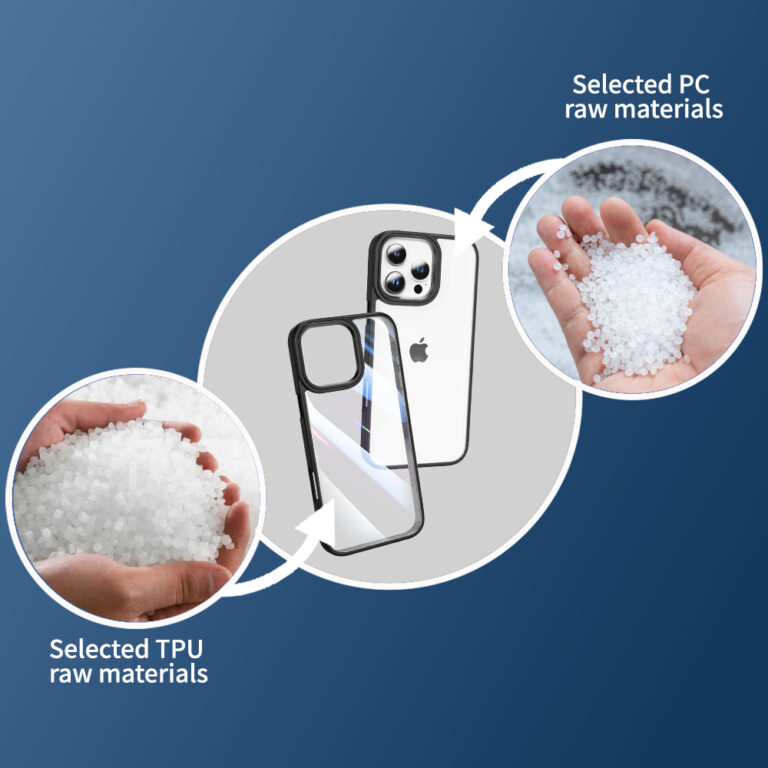
TPU is commonly used for anti-slip edges and flexible grip components. It provides impact absorption and can be molded with ribs or textured patterns.
Its hardness must be selected carefully. Softer TPU may feel more comfortable, while a harder formulation can provide better structural stability. The final choice should also consider surface wear, staining, and the level of protection expected from the case.
Silicone
Silicone provides a soft feel and works well for straps, loops, and grip surfaces. It can also support a premium soft-touch appearance.
Brands should test silicone for dust attraction, staining, tearing, and long-term deformation. A surface that looks clean in a studio sample may behave differently after regular contact with pockets, cosmetics, and skin oils.
PC and Other Rigid Plastics
Polycarbonate and similar rigid plastics are suitable for folding structures, internal supports, and grip housings. They provide dimensional stability but require careful edge design.
Hard corners or narrow contact points can make an otherwise functional grip uncomfortable. Thin plastic components may also crack if the structure is repeatedly opened, twisted, or dropped.
Metal
Aluminum, zinc alloy, and other metals are often used in rings, hinges, and magnetic grip components. Metal can create a more premium appearance and improve structural strength, but it also adds weight.
Finishing quality is especially important. Poor plating, sharp edges, scratches, or inconsistent color can quickly reduce the perceived value of the product.
Fabric and Elastic Materials
Fabric and elastic straps can create a softer appearance and distribute pressure across the hand. Their performance depends on stretch recovery, stitching, bonding, and colorfastness.
These materials should be tested after repeated stretching and exposure to sweat, oil, moisture, and common cosmetic products.
Attachment Methods and Manufacturing Impact
The way a grip connects to the case often determines the project’s complexity.
Integrated Molding
A grip molded directly into the case can provide a clean appearance and strong structural connection. It may also require custom tooling and make future design changes more expensive.
The manufacturer needs to confirm that the structure can be released from the mold properly and that thin sections will fill consistently during injection molding.
Mechanical Assembly
Rings, hinges, folding stands, and rotating components typically require separate assembly. This adds labor and creates additional quality-control points.
Component tolerances must be precise enough to deliver consistent tension. If the fit varies, some units may feel stiff while others become loose after limited use.
Adhesive Attachment
Adhesive grips can reduce initial tooling requirements and speed up development. Their reliability depends on surface preparation, adhesive selection, bonding pressure, and curing conditions.
The bond should be tested under heat, humidity, repeated pulling, and exposure to skin oils. Adhesive failure is particularly damaging because it can cause the phone to fall while the customer is relying on the grip.
Magnetic Attachment
Magnetic attachment gives users more flexibility and makes replacement easier. It also requires accurate alignment and stable magnetic force.
The accessory should be evaluated for direct pull strength and sideways sliding. Real-world use rarely applies force in only one direction.
Not sure whether a grip concept requires a new mold? An early review through an experienced OEM/ODM phone case development process can identify tooling and assembly risks before sampling.

Wireless Charging and Magnetic Compatibility
Wireless charging should be reviewed early in the project. Waiting until the final sample stage can lead to expensive structural changes.
A fixed metal ring or thick grip may increase the distance between the phone and charger. It can also block the charging area or prevent the case from lying flat.
The Wireless Power Consortium’s Qi wireless charging standards use magnetic alignment in Qi2 to support more accurate positioning between compatible devices and chargers. This makes magnet placement, material selection, and structural clearance increasingly important for modern case designs.
Apple also notes that MagSafe charging performance can vary depending on the iPhone model, power adapter, and operating conditions in its official MagSafe charging guidance. For a phone case brand, that means charging claims should be based on tests with the intended case, device, charger, and accessory combination.
Brands should confirm:
- The magnetic ring is centered correctly
- The grip attaches without excessive sliding
- The accessory can be removed easily when needed
- Charging remains stable without the grip attached
- The structure does not generate excessive heat
- The grip works across all intended phone models
- Other magnetic accessories remain compatible
Brands developing a broader accessory system should also review how to select a magnetic phone case for compatible accessories.

Durability Tests Brands Should Require
A grip feature introduces additional failure points. Testing should cover the complete assembled product, not only the case shell or grip component.
Pull and Detachment Testing
This evaluates whether the grip, strap, adhesive, or mechanical assembly can withstand repeated pulling without separating from the case.
Rotation and Folding Cycle Testing
Rotating rings and folding stands should be opened, closed, and turned repeatedly. The goal is to identify loosening, cracking, noise, or loss of holding tension.
Strap Fatigue Testing
Elastic straps and flexible loops should be stretched through repeated cycles. Brands should define how much permanent deformation is acceptable before testing begins.
Abrasion and Coating Testing
Grip surfaces come into frequent contact with fingers, tables, pockets, and bags. Painted, plated, printed, and soft-touch surfaces should be checked for peeling, fading, scratches, and discoloration.
Sweat and Oil Resistance
Sweat, hand cream, sunscreen, cosmetics, and skin oils can affect adhesives, coatings, elastic materials, and color. Testing should reflect the product’s expected use environment.
Drop Testing
The complete case should be drop-tested with the grip installed. The grip must not break into sharp pieces, detach unexpectedly, or weaken the case’s protective structure.
Magnetic Performance Testing
Magnetic grips should be evaluated after repeated attachment cycles and exposure to different temperatures. Pull force alone is not enough; sliding and rotational stability matter as well.

How Phone Case Grip Design Affects Manufacturing Cost
Grip features can increase costs in ways that are easy to overlook during the concept stage.
A custom project may require:
- New tooling or mold modifications
- Magnets and magnetic rings
- Metal hinges or rotation mechanisms
- Adhesives and surface treatment
- Additional assembly labor
- More inspection steps
- Protective films or packaging inserts
- Larger retail packaging
- Replacement components
- Higher after-sales allowances
An existing grip structure is usually faster and less expensive to launch. A fully customized design offers stronger differentiation but requires more engineering, testing, and tooling investment.
Brands should also consider production yield. A complex moving structure may create more cosmetic defects, inconsistent hinge tension, scratches, or assembly failures than a standard phone case.
The lowest component price is not always the lowest total project cost. Tooling, assembly, inspection, packaging, defect rates, and potential returns all need to be included in the evaluation.
How to Evaluate a Phone Case Grip Manufacturer
A phone case grip manufacturer should be able to do more than reproduce a reference image. The supplier needs to understand how the grip affects the case structure, user experience, tooling, assembly, charging compatibility, and quality control.
Before starting a project, evaluate whether the manufacturer can:
- Review the concept for manufacturing feasibility
- Develop or modify molds
- Work with TPU, PC, silicone, metal, magnets, and elastic materials
- Control tolerances across moving components
- Produce functional prototypes
- Perform pull, cycle, drop, abrasion, and magnetic tests
- Manage multi-material assembly
- Support custom colors, logos, finishes, and packaging
- Document quality standards before mass production
- Maintain consistent production across repeat orders
Brands should also ask how the manufacturer handles problems discovered during sampling. A capable partner should explain the practical limitations of the design and suggest alternatives—not simply approve every request.
For a broader sourcing evaluation, review this guide on how to choose a phone case manufacturer.
Common Mistakes Brands Make Before Manufacturing
Several avoidable mistakes can delay development or create problems after launch:
- Approving the grip based only on a rendering
- Testing with one phone size or one hand
- Ignoring wireless charging until the final sample
- Moving a complex mechanism directly into mass production
- Testing the grip separately from the case
- Underestimating wear from sweat and skin oils
- Using the same grip position across very different phone sizes
- Forgetting how the grip changes packaging dimensions
- Failing to define acceptable hinge tension or strap deformation
- Choosing a structure based on unit price alone
These issues are part of a wider group of mistakes brands make when customizing phone cases. The most expensive problems usually appear when design, engineering, and manufacturing are treated as separate decisions.
What to Include in a Phone Case Grip Design Brief
A detailed design brief helps the manufacturer evaluate feasibility before tooling begins.
It should include:
- Target phone models
- Intended customer and use case
- Grip type and required functions
- Fixed or removable construction
- Left- and right-handed requirements
- Portrait and landscape viewing angles
- Material and surface finish
- Color and branding requirements
- MagSafe, Qi2, or wireless charging expectations
- Pull-force and cycle-test targets
- Packaging format
- Expected order quantity
- Target retail price
- Planned launch date
- Reference samples, sketches, or 3D files
If the design includes moving parts, brands should also define what the mechanism should feel like. Terms such as “premium” or “smooth” are subjective. A physical reference sample is usually more useful.
Prototype Before Mass Production
A polished appearance sample is not enough for a grip-focused product. Brands should develop and test a functional prototype before committing to production tooling.
The prototype should be evaluated during:
- One-handed operation
- Extended holding
- Photo and video capture
- Portrait and landscape viewing
- Pocket and bag storage
- Wireless charging
- Magnetic accessory use
- Repeated opening, folding, and rotation
Testing should involve users with different hand sizes and habits. Their feedback can reveal pressure points, balance problems, or reach limitations that are easy to miss during an internal review.
Once the structure is approved, a pilot run can help verify assembly time, production yield, cosmetic consistency, and inspection standards before the full order begins.
Final Phone Case Grip Design Checklist
Before approving a phone case grip design for manufacturing, confirm that:
- The grip is comfortable for different hand sizes
- Both left- and right-handed use have been evaluated
- The phone remains balanced during one-handed operation
- The grip does not block the camera, buttons, or ports
- Wireless charging has been tested
- Magnetic alignment and strength are consistent
- Moving parts can withstand repeated cycles
- Materials resist sweat, oil, abrasion, and staining
- The structure can be manufactured at the required volume
- Packaging protects the grip during transportation
- Functional prototypes have been tested with real users
- Quality standards are documented before mass production
Final Thoughts
A successful phone case grip design must do more than help a product stand out in photos. It should feel natural in the hand, perform reliably over time, and fit within the brand’s manufacturing and pricing strategy.
The earlier a brand evaluates ergonomics, materials, attachment methods, charging compatibility, tooling, and durability, the easier it becomes to avoid expensive mold changes and inconsistent production.
Developing a case with an integrated loop, rotating ring, elastic strap, or magnetic grip? Share your target device, grip concept, material requirements, and estimated order volume with the Runsuncase OEM/ODM team. The team can help evaluate structural feasibility before tooling, sampling, and mass production.
Frequently Asked Questions
What is the most secure type of phone case grip?
The answer depends on the use case. Integrated loops and mechanically assembled rings can provide strong physical support, while magnetic grips offer greater flexibility. Security ultimately depends on the structure, materials, attachment strength, phone weight, and how the user holds the device.
Do phone grips interfere with wireless charging?
Some do. Fixed metal components, thick structures, and grips positioned over the charging coil may interfere with wireless charging. A removable magnetic grip allows users to detach the accessory before placing the phone on a charger.
Is an integrated grip better than a removable grip?
An integrated grip can provide a cleaner appearance and more stable connection. A removable grip offers greater flexibility and is often easier to use with wireless chargers and other magnetic accessories. The better option depends on the target user and product strategy.
What materials are commonly used for phone case grips?
Common materials include TPU, silicone, polycarbonate, aluminum, zinc alloy, elastic fabric, and combinations of these materials. Each offers different advantages in comfort, durability, weight, appearance, and manufacturing cost.
How should a phone case grip be tested?
Testing should include pull strength, rotation or folding cycles, strap fatigue, surface abrasion, sweat resistance, drop performance, and magnetic stability where applicable. Testing should be performed on the complete assembled case.
Can phone case grips be customized?
Yes. Brands can customize the grip’s shape, color, material, texture, logo, printed artwork, surface finish, and mechanical structure. Available options depend on the grip type, manufacturing process, and order quantity.
Does a custom phone case grip require a new mold?
Not always. Removable grips and existing structures may only require color, logo, or packaging changes. A fully integrated or structurally unique grip will usually require a new mold or modifications to an existing one.